← Knowledge · Updated 6 November 2026 · 5 min read
Purity and peptide content are often confused. The difference matters when you calculate stock solutions.
Two different quantities
Purity describes the target peptide’s share of the peptidic components. Peptide content describes the share of peptide in the whole weighed mass. The rest is mainly counterions and residual water.
Where the difference comes from
Peptides are often isolated as salts, such as trifluoroacetate or acetate, and lyophilisates also take up moisture. So a peptide can have high HPLC purity and still a clearly lower peptide content.
How high the content is depends on the sequence. Peptides with many basic residues such as lysine and arginine bind more counterions. Values between about 60 and 90% are not unusual for peptide salts.
What the weighed material consists of
A made-up example for 100 mg of lyophilisate with 80% peptide content and 97.5% purity:
| Component | Amount | Counts towards |
|---|---|---|
| Target peptide | 78 mg | Peptide content and purity |
| Peptidic by-products | 2 mg | Peptide content, but not purity |
| Counterion, such as trifluoroacetate | 13 mg | Neither |
| Residual water | 7 mg | Neither |
The purity of 97.5% refers to the 80 mg of peptide. The peptide content of 80% refers to the whole 100 mg.
How much counterion a peptide carries
Every positively charged group in a peptide binds a counterion. That includes the N-terminus and the side chains of lysine, arginine and, depending on conditions, histidine. A trifluoroacetate ion weighs about 114 g/mol, an acetate ion about 60 g/mol.
A worked example: a 1000 g/mol peptide with four positively charged groups carries four counterions as a trifluoroacetate, together about 456 g/mol. Even without water, the peptide content is then at most 1000 ÷ 1456, or about 69%. As an acetate it would be 1000 ÷ 1240, about 81%. This explains why short, strongly basic peptides often have a low peptide content.
Residual water and humidity
Lyophilisates usually hold a few percent of residual water after freeze-drying. If a vial is opened cold or left open for long, the powder takes up more water from the air. The weighed mass gets heavier without containing more peptide. So weigh quickly and at room temperature. Handling guidance is in Storing peptides.
What this means for your preparations
If a peptide content value is available, use it to correct the weighed mass:
peptide mass = weighed mass × peptide content
In sensitive cell experiments the counterion itself can also matter, so check which salt the CoA states.
Worked example for a stock solution
Say you need 1 ml of a 1 mM stock solution of a peptide with a molecular mass of 1000 g/mol. That takes 1 mg of peptide.
weighed mass = concentration × volume × molecular mass ÷ peptide content
At a peptide content of 80%, you weigh out 1.25 mg of lyophilisate, not 1 mg. Without the correction the real concentration would be 20% below target.
When no peptide content is stated
Not every certificate gives the peptide content. Then you have two options. You can roughly estimate it from the counterion and the number of charged groups, as shown above. Or you can measure the concentration photometrically after dissolving. If the peptide contains tryptophan or tyrosine, the extinction coefficient at 280 nm can be calculated from the sequence: about 5500 M⁻¹cm⁻¹ per tryptophan and 1490 M⁻¹cm⁻¹ per tyrosine. With the measured absorbance this gives the real concentration.
Weighing small amounts accurately
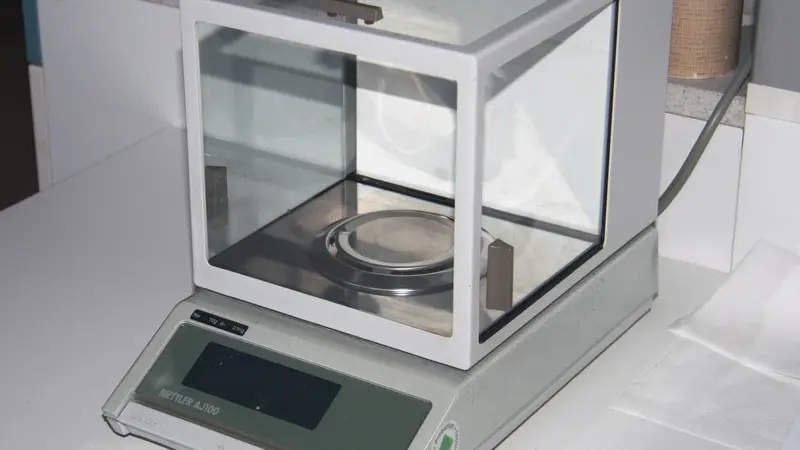
Amounts below a milligram can only be weighed roughly, even on an analytical balance, especially as lyophilisates can carry static charge. It is often more accurate to dissolve the whole content of a vial in a known volume and calculate the concentration from that. The solution can then be split into aliquots.
Common calculation mistakes
- Forgetting peptide content: the weighed mass is treated as pure peptide. The solution then comes out too weak.
- Using purity instead of peptide content: HPLC purity is used for the correction. Since it is usually much higher than the peptide content, almost all of the error remains.
- Counting the salt mass twice: calculating with the salt’s mass and also deducting the peptide content. The concentration then comes out too high.
- Reading the label amount as net amount: “5 mg” refers to the lyophilisate, not the pure peptide.
Counterion exchange
For cell work, a trifluoroacetate salt is sometimes converted to an acetate or hydrochloride salt. This is done by ion exchange or by repeatedly dissolving and freeze-drying from dilute acid. The mass of the counterion changes, and with it the peptide content. After an exchange, the old figure no longer applies. Ask the supplier which salt is present and whether an exchange was carried out.
Stating amounts in protocols and publications
For others to reproduce an experiment, the amount should be stated clearly. Say whether a concentration refers to the weighed mass or to the net peptide amount. Give the salt, the supplier and the lot number. A statement such as “1 mM, based on peptide content per CoA, acetate salt” leaves no questions open.
Purity, peptide content and net amount at a glance
| Term | Relative to | Typical method |
|---|---|---|
| Purity | All peptidic substances in the sample | RP-HPLC, area percent |
| Peptide content | The whole weighed mass | Amino acid analysis, nitrogen determination |
| Net peptide amount | The peptide in the vial | Weighed mass × peptide content |
Which of these a certificate should state is in How to read a peptide certificate of analysis. What to look for when buying is under Peptide content and batch testing.
Common questions
Why do two lots differ in peptide content? Because counterion exchange, drying and residual moisture vary from run to run. So the figure always applies only to the lot tested.
Is an acetate salt better than a trifluoroacetate? For many cell experiments, yes, because trifluoroacetate can interfere at higher concentrations. For analytical purposes it usually makes no difference.
Which molecular mass do I use for calculations? The mass of the free peptide, combined with the peptide content. Alternatively you can use the mass of the salt if you know how many counterions are bound. Don’t mix the two approaches.
For laboratory research use only. Not for use in humans or animals.